Do food-centered holiday social events make you feel a bit anxious? Is it because you find yourself eating foods that aren’t the most satisfying or eating to the point of feeling uncomfortably full? Here are some mindful holiday eating tips that might help you enjoy that next holiday party or buffet more.
One. Relax rules for what, when and how much you eat.
- When certain foods are labeled as forbidden, you want them even more. Let your body take the lead and tell you what feels good and what doesn’t.
- Sometimes cake or Christmas cookies are the best choice, because pleasure has a role in healthy eating. But if you deny yourself these foods, you are likely to end up overeating. Sometimes it’s all about the dose: a little bit can be just what you need, but a lot is not what you need.
- Honor your physical hunger and give yourself the absolute right to eat when you are hungry, regardless of when that hunger happens. This may mean learning to tell the difference between physical and emotional hunger.
- Sometimes we need more food, sometimes we need less. This depends partly on energy needs, but when it’s a special holiday food that you only have once a year, you may need more to feel satisfy. Tuning in to how much you really need can help you avoid eating more than you need just because you eat more than you think you “should” eat (aka the “heck with it all” mentality).
Two. Feed yourself predictably
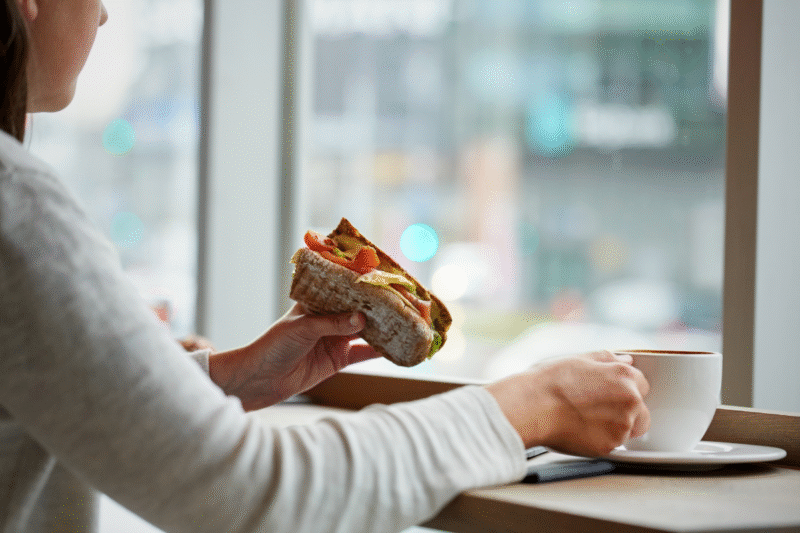
- Support your body in what it really needs and wants. This is about managing hunger, which is a very powerful physiological drive. When you manage hunger, you increase your ability to make choices that are in your own best interest.
- When you skip meals and restrict calories, you get out of balance. Hunger is like a rubber band: if you pull it back gently it bounces back to the middle, if you pull it too far it bounces across the room.
- When you get into a cycle of undereating then overeating, you have trouble recognizing hunger until it get into the extremes.
- If you do have trouble recognizing hunger, eating on a more structured schedule may help you while you work on getting more in touch with your hunger cues (it’s like training wheels).
Three. Eat slower and savor
- If you eat quickly, you lose out on the pleasure of eating.
- Many people eat quickly because they are engaging in negative self-talk about what or how much they should be eating. That negative self-talk is unpleasant, and when you’re beating yourself up because you are eating something you “shouldn’t,” you often eat fast to get through it, and not only do you feel bad about yourself, but you find little true pleasure in the food itself.
- Of course, some of us eat too fast due to pure habit, but it’s a habit worth breaking, because eating slowly is also important for digestion and metabolism. Eating fast puts stress on your body.
Four. Nourish yourself well
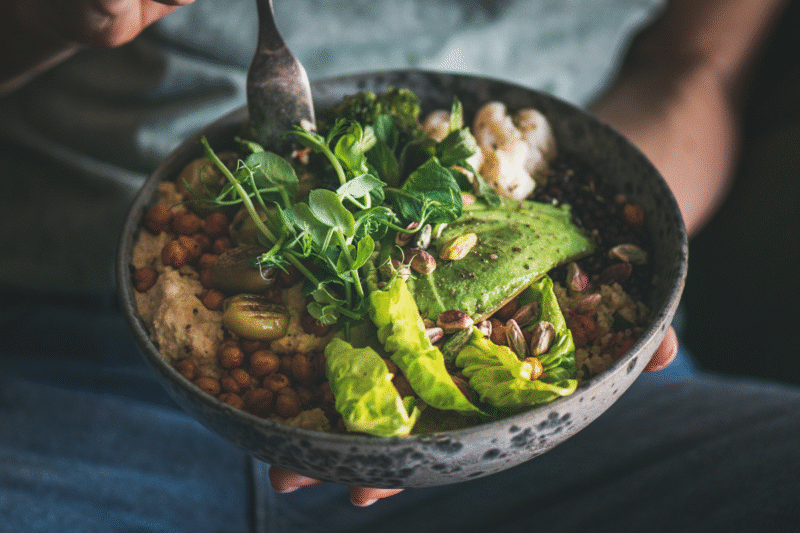
- This is about letting your bodies tell you what it really needs. It’s about eating in balance and eating foods that make you feel well while you are eating them and after.
- Food is one of the greatest pleasures in life, and pleasure is good medicine. The trick is to find the right dose, and you can do that by being mindful and trusting your body to tell you what you need.
Five. Be open to experimenting
Approach eating with an open mind and let go of idea of what you should and should not eat and observe the experience. Part of mindful eating is figuring out what feels good to eat and in what amounts. There are no mistakes, just try something and see how it works for you. Try asking yourself three questions:
- “Am I hungry?” You don’t always have to be hungry when you eat, but it’s good to notice if you are. If you are often are not hungry when you eat, than that suggests that it’s an issue to explore. Are you eating emotionally?
- “What do I want to eat?” This gets you back in touch with how your body talks to you. Once you are eating, stay present. Ask yourself if you like the food. Many people eat even when they don’t like something, just because it’s on your plate.
- During the meal, check in with yourself and ask “Have I had enough?” This may depend on your hunger level and/or how much pleasure you are still getting from the food. Keep an open, curious mind instead of a judgmental mind.
A tale of two holiday parties
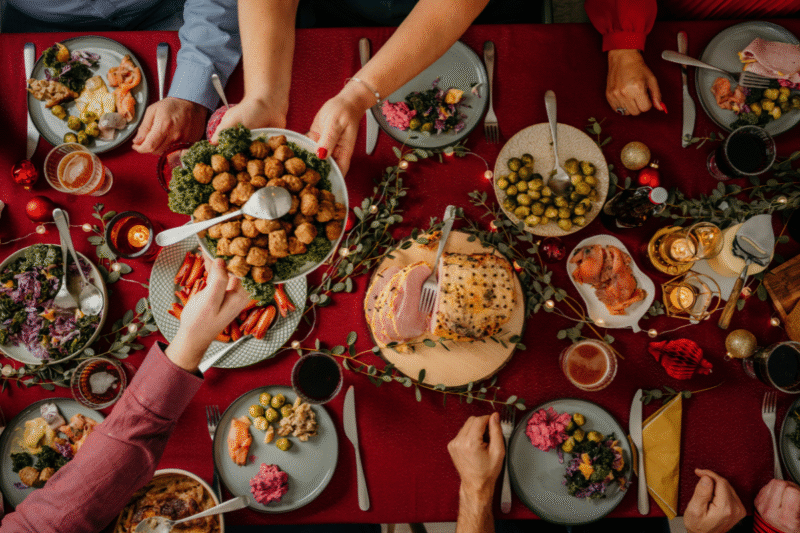
Let’s look at two different parties. Or, rather, the same party under two very different scenarios:
Scenario # 1
You arrive at the holiday party ready to have fun. You knew there would be lots of great food so you saved as many calories as you could during the day. You skipped breakfast and ate a big salad with lots of veggies, tuna and fat-free dressing for lunch then drank black coffee or diet cola whenever you got hungry. After all, you knew you’d be up late tonight. You don’t feel that hungry when you get to the party but after a drink, you take a few bites of that delicious artichoke dip. Then you have a bit more, and a bit more, and then the dinner buffet starts. Since you ate all that dip anyway, you just go for broke, filling your plate, eating it all, then going back for more.
As you’re eating, you start to feel guilty about how much you’re eating. In fact, you’re practically oblivious to the conversation going on around you because you’re all up in your head with self-critical thoughts. Then the feeling of fullness really kicks in and you realize you are stuffed to the point that your stomach hurts. Even though many of the foods you ate were delicious, you take no pleasure from the memory because of your physical and mental discomfort. You’re already planning how little you will eat and how much you will exercise the next day to make up for the “damage” you’ve done.
Scenario #2
You arrive at the holiday party ready to have a good time. You knew there would be lots of good food at the party and you wanted to enjoy it. You knew your best bet for doing that was to come to the party well-nourished, not too hungry but hungry enough so the food tasted good and you had room to eat. So you ate breakfast and lunch and even a light snack when you felt a little hungry later in the afternoon.
You have a drink and put a few tasty-looking appetizers on your plate. You taste each one, and slowly eat the ones you enjoy but leave the ones you find you really don’t enjoy the taste of. When dinner is ready, you check out the buffet and take some of everything you think you’d like to eat. Just as with the appetizers, you taste each food, choosing not to eat the ones you don’t like. After you finish, you assess whether you are satisfied. You decide you would like to eat a bit more so you go back for some of the foods you really enjoyed. You eat most of what you got for seconds but stop before you clean your plate because you find the food wasn’t tasting as good anymore and you felt full.
So, which scenario do you prefer?
Disclaimer: All information provided here is of a general nature and is furnished only for educational purposes. This information is not to be taken as medical or other health advice pertaining to an individual’s specific health or medical condition. You agree that the use of this information is at your own risk.
Hi, I’m Carrie Dennett [1], MPH, RDN, a weight-inclusive registered dietitian, nutrition therapist and body image counselor. I offer compassionate, individualized care for adults of all ages, shapes, sizes and genders who want to break free from eating disorders, disordered eating or chronic dieting [2]. If you need to learn how to manage IBS symptoms [3] with food, or improve your nutrition and lifestyle habits [4] to help manage a current health concern or simply support your overall health and well-being, I help people with that, too.
Need 1-on-1 help for your nutrition, eating, or body image concerns? Schedule a free 20-minute Discovery Call [5] to talk about how I can help you and explore if we’re a good fit! I’m in-network with Regence BCBS, FirstChoice Health and Providence Health Plan, and can bill Blue Cross and/or Blue Shield insurances in many states. If I don’t take your insurance, I can help you seek reimbursement on your own. To learn more, explore my insurance and services areas page [6].