
If not dieting, then what? That question tends to loom heavy in your mind when you’ve decided it’s time to get off the diet rollercoaster, but aren’t sure what life after dieting would look like. And there are many reasons for saying goodbye to dieting, a.k.a. the intentional pursuit of weight loss.
- Maybe you’re tired of the lose-regain-lose cycle — a.k.a. yo-yo dieting — or you’re (rightly) concerned that continuing to yo-yo isn’t doing your physical health and emotional well-being any favors.
- Perhaps you are tired of never feeling certain about what to eat. Is this food bad? Is that food good? And do the answers change depending on whether you’re talking about eating to support health or eating to promote weight loss?
- Maybe you are sick of feeling like you can’t fully live your life when you continue to diet. You’re either on a diet or thinking about starting a new diet, taking up mental bandwidth you could be devoting to something else. Plus, when you are on a diet, you find it difficult to go to a restaurant, a party or a vacation without worrying whether there will be something that you’re “allowed” to eat.
- Or, do you find that the diet rollercoaster leaves you swinging between being tightly controlled and being totally out of control [1]? This restrict-binge cycle [2]isn’t good for health, it certainly isn’t good for your well-being (oh, the guilt!) and it doesn’t allow you to settle into a place where you can find peace with your food choices.
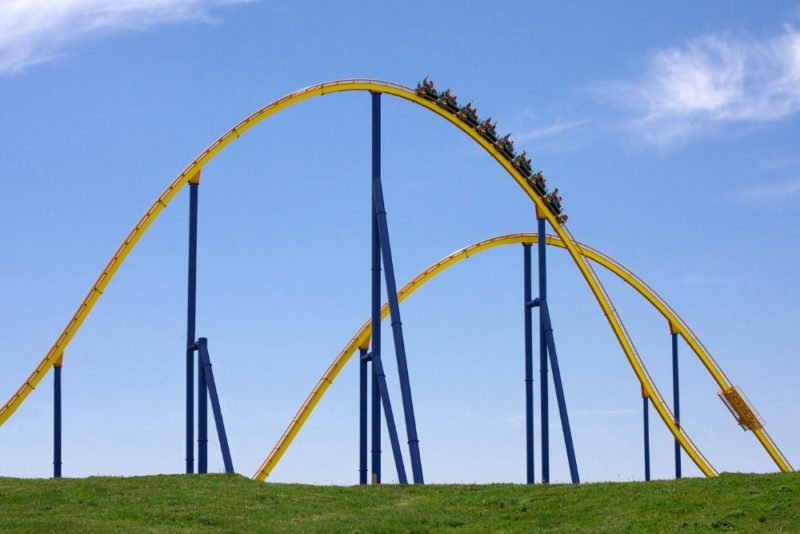
How to get off the diet rollercoaster
Generally, when you remove something from your life, you replace it with something else. You fill the vacuum left behind. For example, if you start spending less time watching TV, you might start reading more. Or, if you decide to stop dieting, you might start practicing intuitive eating so you can learn to replace restrictive diet rules with the guidance of your body’s natural hunger and fullness cues. If your years — or decades — of dieting were fueled by poor body image, you might start working on ways to cultivate body respect instead of body hatred [3].
After years (or decades) of following external rules about what, when and how much to eat, it’s important to:
- Start rebuilding trust in what your body tells you about what foods feel good, when it needs to be fueled, and what amounts feel just right.
- Learn to appreciate your body for what it does, not how it looks, and to feel and experience your body from the inside out rather than always watching yourself from the outside.
- Come to terms with what events or experiences launched you into Dietland, which goes smoother if you can start trading self-judgement for self-compassion.
- Learning new ways of coping with difficult emotions if turning towards food (or turning away from food) was your go-to before.
This work can be challenging, but it’s essential, because otherwise the vacuum left by simply stopping dieting can suck you back into Dietland. When you have an unkind body day, when a pair of pants doesn’t fit, when you feel bloated (for any one of the millions reasons we might feel bloated), it’s easy to feel the urge to “fix” things with a diet.
Resources to help you navigate a new course
The longer you’ve been dieting, the longer it can take to fully give it up. By fully, I mean not just deciding not to go on anymore diets, I mean untangling yourself from diet mindset and embedded diet rules. Yes, it is possible to not be consciously dieting but to still be subconsciously dieting. I see it ALL THE TIME.
This is where many of my 1-on-1 clients [4] are stuck when they start working with me. They wonder why they feel so food obsessed and icky about their bodies because they’ve given up dieting, so all should now be cool, right? That’s just one more place where self-judgement can creep in, along with shame. If you’re stuck in that messy middle [5], here are some of the books I recommend to my own clients, and to anyone who wants to leave dieting in the rearview mirror and move forward to a balanced, peaceful relationship with food, nutrition and their body.
- “Intuitive Eating: A Revolutionary Anti-Diet Approach [6]” (and the workbook [7]) by Evelyn Tribole, MS, RDN, and Elyse Resch, MS, RDN
- “Radical Belonging: How to Survive and Thrive in an Unjust World (While Transforming it for the Better) [8]” by Lindo Bacon, PhD
- “More Than A Body: Your Body Is an Instrument, Not an Ornament [9]” by Lindsay Kite, PhD and Lexie Kite, PhD
- “Unapologetic Eating: Make Peace with Food and Transform Your Life [10]” By Alissa Rumsey, MS, RD
- “Anti-Diet: Reclaim Your Time, Money, Well-Being, and Happiness Through Intuitive Eating [11]” by Christy Harrison, MPH, RD
This post contains Amazon Affiliate links. As an Amazon Associate I earn from qualifying purchases.
Disclaimer: All information provided here is of a general nature and is furnished only for educational purposes. This information is not to be taken as medical or other health advice pertaining to an individual’s specific health or medical condition. You agree that the use of this information is at your own risk.
Hi, I’m Carrie Dennett [12], MPH, RDN, a weight-inclusive registered dietitian, nutrition therapist and body image counselor. I offer compassionate, individualized care for adults of all ages, shapes, sizes and genders who want to break free from eating disorders, disordered eating or chronic dieting [13]. If you need to learn how to manage IBS symptoms [14] with food, or improve your nutrition and lifestyle habits [15] to help manage a current health concern or simply support your overall health and well-being, I help people with that, too.
Need 1-on-1 help for your nutrition, eating, or body image concerns? Schedule a free 20-minute Discovery Call [16] to talk about how I can help you and explore if we’re a good fit! I’m in-network with Regence BCBS, FirstChoice Health and Providence Health Plan, and can bill Blue Cross and/or Blue Shield insurances in many states. If I don’t take your insurance, I can help you seek reimbursement on your own. To learn more, explore my insurance and services areas page [17].