
This post is sponsored by The Alliance For Food and Farming [1] (@SafeProduce), who also paid for my travel to Monterey for this amazing tour. I learned a lot on this trip, and what I chose to present in this blog post was entirely up to me.
I had the amazing opportunity to travel to Monterey, California last week with seven other dietitians to tour some farms and talk to farmers and scientists about farming and food safety. The tour took us to parts of the Salinas Valley—setting for many John Steinbeck novels, FYI—and Watsonville, which have perfect microclimates for many of the fruits and veggies you love.
Whether it’s at a farmers’ market or on a farm tour, I love to talk to the people who work hard—and farming is HARD work—to grow my food. I like to learn about their struggles and their innovations, and what they’re doing to meet our needs as eaters, while taking care of their land so their children can continue the farming tradition, if they choose.
This is a long post, but I cover some important information about food safety, and offer up some Fun Facts, Food For Thought, Smart Tips…and one Secret Tip!
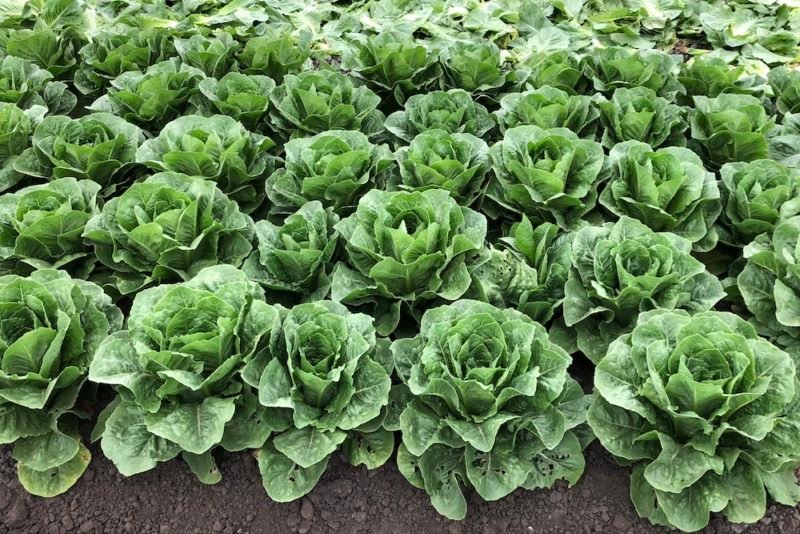
Food safety (or, some major myths and facts about farming)
When it comes to food safety, what’s your biggest concern, pesticides or pathogens? My hand’s in the air for pathogens, because while pesticide use is tightly regulated, and the technology for detecting pesticide residues is extremely sophisticated, preventing pathogens from traveling from farm to food is not as easy. The idea that you don’t have to worry about food safety if you buy organic? I wish it was that easy?
Pesticides are designed to be toxic, and, yes, they do show up in food, so of course people are concerned, said Carl Winter, PhD, a just-retired food toxicologist from the University of California Davis. However, as he pointed out, “It’s the dose that makes the poison.” In other words, it’s the amount, not the presence or absence of a pesticide, that matters. The amount of residues allowed on food is a drop in the bucket compared to the amount that could cause harm. Unfortunately, many people are eating fewer fruits and vegetables because of pesticide fears.
Side Note: I’ve written about the [2]Environmental Working Group’s “Dirty Dozen” [2]list previously [2]. The criteria they use to create their list—how many different residues are found on different types of produce—is not the criteria you would use if you actually wanted to assess health risks. Whether pesticide residues are a health concern depends on how much of a specific residue is found on the produce, how much an eater would likely be exposed to (for example, is it a type of produce that’s typically peeled, or not), and how toxic are those specific residues (some pesticides are considered more toxic than others).
If you wonder why organic produce often costs more than conventional produce at the grocery store, it’s because organic farming is more expensive—many people think that “organic” means that the farmer doesn’t have to actually “do” anything., but that is FAR from the truth. In talking with experts and farmers, it’s amazing how little difference there is between organic and conventional crops. Many farmers grow both, and apply the same care and attention to both crops. If the marketplace reaches the point where farmers can’t get more for their organic crops, many will likely convert some of their acreage back to conventional.
Food for thought:
- Pesticides are expensive, so no farmer is going to be applying it if they don’t need to, and then no more then they absolutely have to.
- While most pesticides approved for organic agriculture are naturally derived, some don’t work well and have to be applied a lot. Some pesticides, such as sulfur, are approved for both conventional and organic agriculture. Organic farmers can use non-organic pesticides on a limited basis in an emergency—such as a major pest infestation—and we as consumers would never know.
- Pesticides help protect crops from bug damage, and keep bugs out of your salad mix.
In case you’re curious, I buy both organic and conventional produce, with price and quality being the main decision drivers. Based on everything I know about organic agriculture, I think there are valid reasons to buy organic, but I have no fears about buying conventional.
Strawberry Fields Forever
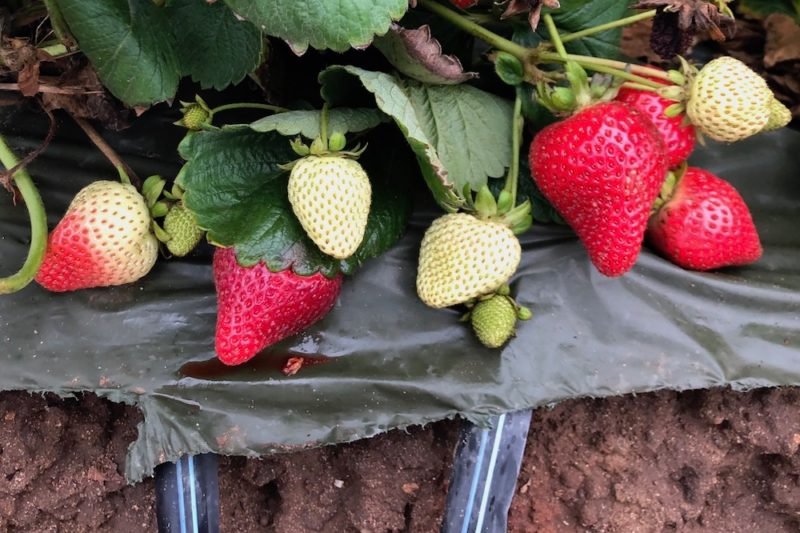
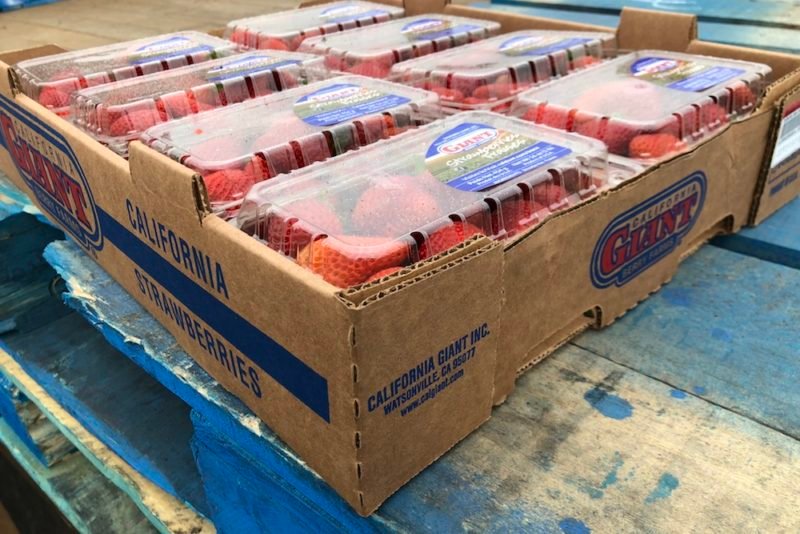
I had fun talking with Carolyn O’Donnell, communications director for the California Strawberry Commission. California has 31,000 acres of Strawberries—all family farms—and produce 85 percent of the strawberries in the U.S. The weather in the Salinas and Watsonville areas of California are perfect, with their warm days and cool nights—not too hot, not too cold.
While there’s never been a major foodborne illness from domestic strawberries (knock wood), the California Strawberry Commission places a strong focus on food safety in the field, since strawberries are picked straight into the containers you see in your grocery store. (Side note: Strawberry pickers are highly skilled laborers…I dare you to empty a full clamshell container of strawberries then put them all back so they fit neatly.) This starts with:
- Growing strawberries in raised beds on top of black plastic mulch, which warms the soil and makes the berries easier to pick, plus reduces exposure to any soil-borne pathogens.
- Using drip irrigation, which saves water, reduces exposure to any water-borne pathogens and keeps the berries drier, thus reducing the risk of bacterial or fungal growth.
- Hammering home the importance of hand washing to field workers.
- Chilling the fruit to 32 degrees as soon as possible after picking (within 4 hours, at the most) and transporting them on trucks that are kept to 32-24 degrees.
We visited California Giant Berry Farms, where it was cool to see these safety measures in action—and to eat strawberries straight off the plant. Did you know that many strawberry farms are run by the children or grandchildren of immigrants? It’s true.
Fun Fact: Strawberry farmers use bug vacuums to suck up pests, reducing the need for pesticides and also preventing damage to the fruit.
Food For Thought: The last person to handle your berries was probably the pickers, so even though hand washing is a standard practice, and even though the berries are kept as clean as possible while growing, please rinse them before eating.
Smart Tip: Take the amount of berries you want to eat out of the refrigerator 30 minutes before you plan to eat them, rinse them and set them aside. This cleans them and brings out their flavor.
Let Us Eat Lettuce
Did you know that strawberry crops are often alternated with lettuce crops (strawberries one year, lettuce the next)? Well, now you do! Broccoli is also a good alternator with strawberries. This helps prevent depleting the soil, as lettuce and broccoli don’t lean heavily on the same nutrients that strawberries do. This also helps prevent any diseases that favor one particular crop from setting up shop in the soil. We watched romaine lettuce being harvested at Taylor Farms, and iceberg lettuce harvested at Dole. The air literally smelled like lettuce (something I’ve never experienced, I don’t know about you).
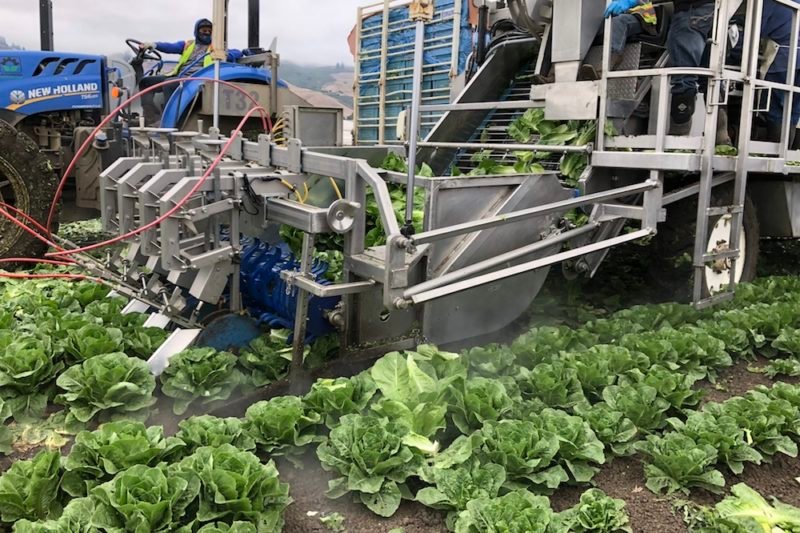
The photo above is of romaine being harvested by a water jet harvester, which increases both food safety (more sanitary), shelf life (by reducing browning at the cut stem end) and yield (it can adjust cutting height in uneven fields). So cool!
I can’t talk about lettuce and farms without talking about the recent romaine lettuce food borne illness outbreaks. So, what exactly happened?
“The ability of organisms to move onto crops is a complex process,” said Bob Whitaker, PhD, chief science and technology officer for the Produce Marketing Association (OK, I totally science-geeked out talking to him). He said they’re learning more and more about the farm environments, which are biological systems that are constantly growing and changing. Some of the most likely culprits are surface water—think ponds, lakes, streams, canals and irrigation ditches—and the presence of animals, whether it be birds, dogs or nearby livestock. Well water isn’t likely to be contaminated.
Whitaker said the culprit in the romaine outbreaks was likely a surface source of irrigation water, but that’s not 100 percent certain. What is certain is that there are conditions in the field that can cause contamination, and that’s something the industry is working hard on. This includes revising their practices to limit overhead watering, keep animals away from irrigation sources, etc. Farm equipment that used be sanitized once a year (yes, really) is typically sanitized daily.
In the fields I toured, food safety inspectors from one of the major cooperatives the farm belongs to walk the fields the day before harvest, documenting any problems (pests, disease, contamination from bird poop, etc.) in an app. This can identify any segments of the field that should not be picked, as well as making sure that the produce is at peak readiness.
Fun fact: Iceberg lettuce straight from the field, still cool but a tiny bit sunwarmed, is awesome, and this is coming from someone who has previously dismissed iceberg.
All About Artichokes
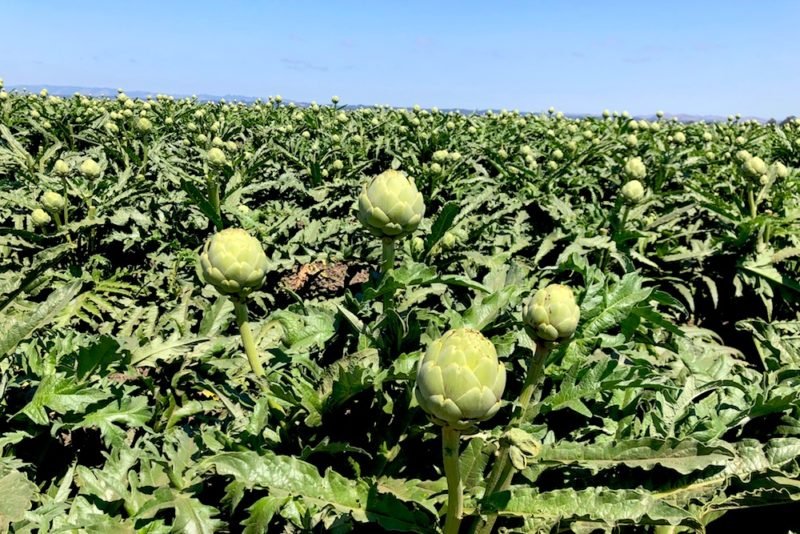
We saw celery and artichoke farms from Ocean Mist® Farms—which grows most of the artichokes in the U.S., by the way—and as with lettuce, I never thought I would say the words, “The air smells like celery,” but it did! I consider myself an artichoke early adopter, eating them since early childhood (I lived in California until I was 10). I adore them, even if they are messy to eat. 100 percent worth it!
If you want evidence that working on a farm is no picnic, the artichoke pickers wear huge open-topped backpacks, then walk down each row, picking, until they reach the end, trade their full backpack for an empty one, then turn around to start picking the adjoining row. They cover 7 to 11 miles per day, and their base pay goes up when the pickings are slimmer, because they have to work harder.
Fun Fact: Artichokes hail from Italy, and were originally all perennial plants, but it took years to reach peak production, so annual plants were bred from them, and that’s what you see in the fields today.
Smart Tip: When choosing artichokes at the grocery store or market, DON’T choose large artichokes with skinny stems. Why? Because the stem is an extension of the artichoke’s heart (that fleshy part that I consider the prize), so a skinny stem means a smaller heart!
Secret Tip: Cook your artichokes in an Instant Pot (if you have one). One of the industry guys on the tour says he’s constantly testing new varieties of artichokes, and got tired of steaming them the old fashioned way. 12-15 minutes in the Instant Pot, and they’re done, he said. Use the steamer insert, and cook on high pressure.
My takeaways (or, final food for thought)
As has been the case when I’ve had the opportunity to tour other types of farms—California walnuts and almonds, Florida citrus—I’m awed by the care, attention and tremendous hard work that goes into these farm. And these are all family farms, too. We tend to think of family farms as those who show up at your local farmer’s market, but family farms can operate on slightly larger scales, too. These farms are their homes, their lives—and they were their grandfathers’ lives. All of them are planning three, four, five years ahead, weathering the vagaries of the market, and the weather itself. Respect!
Check out my Instagram Stories [3] to see more photos…and short videos!
Disclaimer: All information provided here is of a general nature and is furnished only for educational purposes. This information is not to be taken as medical or other health advice pertaining to an individual’s specific health or medical condition. You agree that the use of this information is at your own risk.
Hi, I’m Carrie Dennett [4], MPH, RDN, a weight-inclusive registered dietitian, nutrition therapist and body image counselor. I offer compassionate, individualized care for adults of all ages, shapes, sizes and genders who want to break free from eating disorders, disordered eating or chronic dieting [5]. If you need to learn how to manage IBS symptoms [6] with food, or improve your nutrition and lifestyle habits [7] to help manage a current health concern or simply support your overall health and well-being, I help people with that, too.
Need 1-on-1 help for your nutrition, eating, or body image concerns? Schedule a free 20-minute Discovery Call [8] to talk about how I can help you and explore if we’re a good fit! I’m in-network with Regence BCBS, FirstChoice Health and Providence Health Plan, and can bill Blue Cross and/or Blue Shield insurances in many states. If I don’t take your insurance, I can help you seek reimbursement on your own. To learn more, explore my insurance and services areas page [9].